CourseKata Chapter 6: Part III (Sec 5 to 11)
Sampling
Empirical Rule is an Approximation
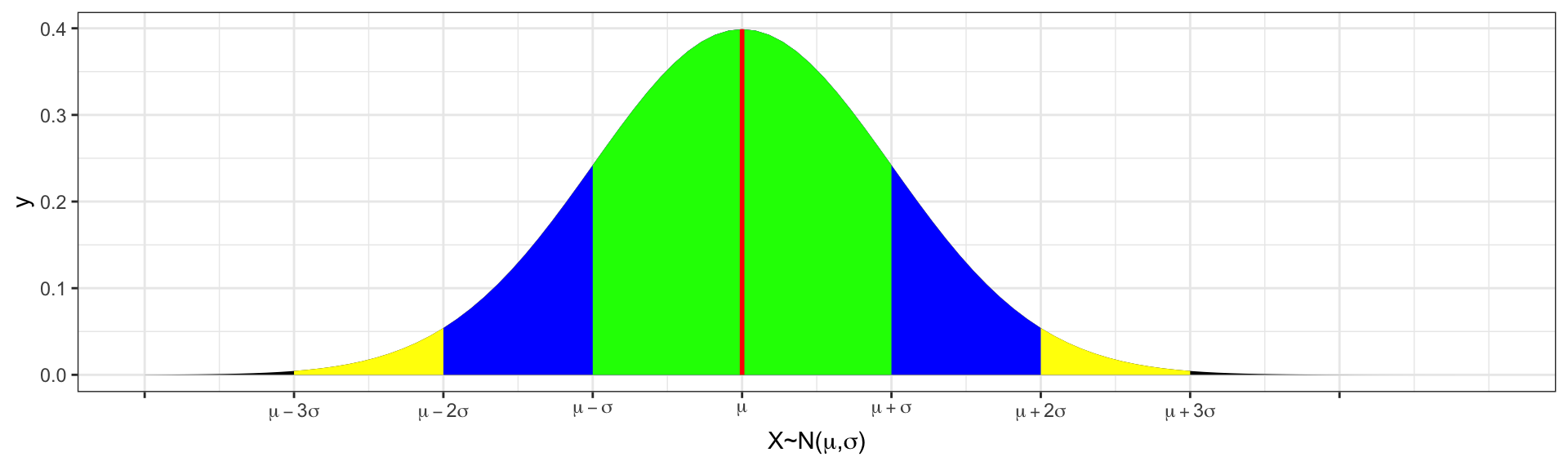
- Area within 1 SD from the mean:  0.6826895
- Area within 2 SD from the mean:  0.9544997
- Area within 3 SD from the mean: 0.9973002 Evaluate the Fit
Normal Approximation of Student Thumb Length:
- Recall Empirical Rule
- \(P(\mu-\sigma, \mu+\sigma)=68\%\)
- \(P(\mu-2\sigma, \mu+2\sigma)=95\%\)
- \(P(\mu-3\sigma, \mu+3\sigma)=99.7\%\)
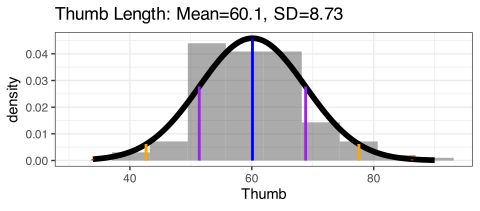
- Proportions:
1-SD: 0.6942675 2-SD: 0.9363057 3-SD: 0.9872611- Not a Great Approximation; but OK!
Generic vs Standard Normal
- Recall Empirical Rule
- \(P(\mu-\sigma, \mu+\sigma)=68\%\)
- \(P(\mu-2\sigma, \mu+2\sigma)=95\%\)
- \(P(\mu-3\sigma, \mu+3\sigma)=99.7\%\)
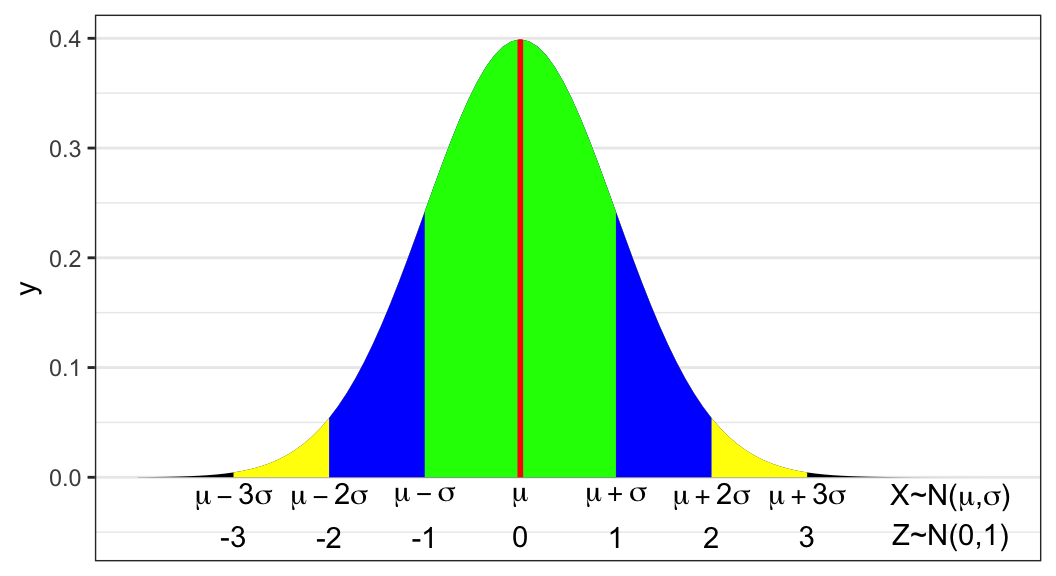
- Each Normal is equivalent to Standard Normal
\[X\sim N(\mu, \sigma) \Leftrightarrow Z\sim N(0, 1)\]
\[X = \mu + Z\cdot \sigma \Leftrightarrow Z=\frac{X-\mu}{\sigma}\]
Application of \(Z\):
Within Group Comparison
  Gender     mean       sd
1 female 64.51830 2.662054
2 male 69.50222 2.937647- Which one is taller in their group:
- A 68-inch female student
- A 72-inch male student
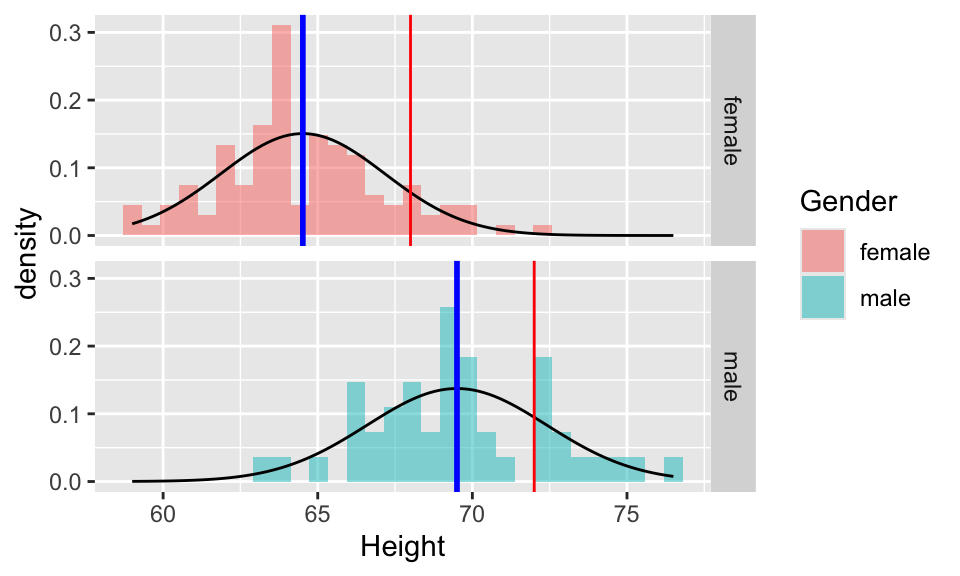
Female: Z = (68.00-64.52)/(2.662)
    = 1.308

Male: Z = (72.00-69.50)/(2.938)
    = 0.850
Application of \(Z\):
Between Group Decision
- A student is 68 inches; is the student male or female?
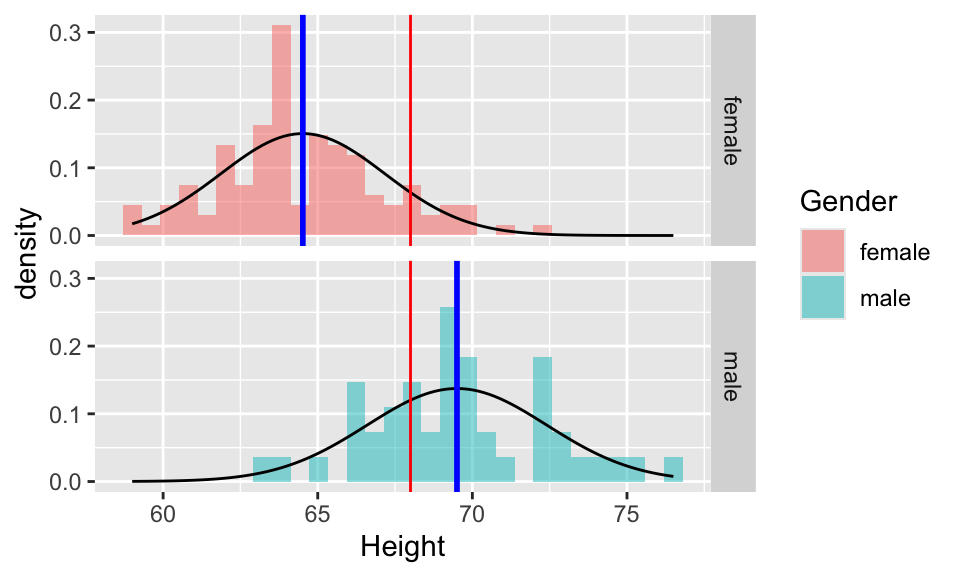
- Which is more unlikely?
- From female group? \(P(Height > 68)\)
- From male group? \(P(Height < 68)\)
Female: P(Height>68)=P(Z>1.31)=0.0893
Male: P(Height<68)=P(Z<-0.51)=0.2667