CourseKata Chapter 11

Model Significance (1)

Mansour Abdoli, PhD

Overview / Goals

  • Assumption \(\rightarrow\) Null Dist. \(\rightarrow\) Observation
  • Theoretical Null Distribution
  • Test of Significance: \(\beta_1\)
  • Type I and Type II Errors

Assumption \(\rightarrow\) Null Dist. \(\rightarrow\) Observation

Sampling Variability

  • Different samples → different statistics
  • Statistics vary naturally

Key idea:

Variation is normal, not suspicious

Sampling Distribution

  • Distribution of a statistic across many samples
  • Built by:
    • Re-sampling OR
    • Mathematical theory

Null Distribution

Null Hypothesis (\(H_0\)):

  • Assumption:
    • No effect
    • No difference
    • No relationship
  • Null Distribution of \(b_1\):
    • Categorical Explanatory
      • Mean difference = 0
    • Quantitative Explanatory
      • Slope = 0

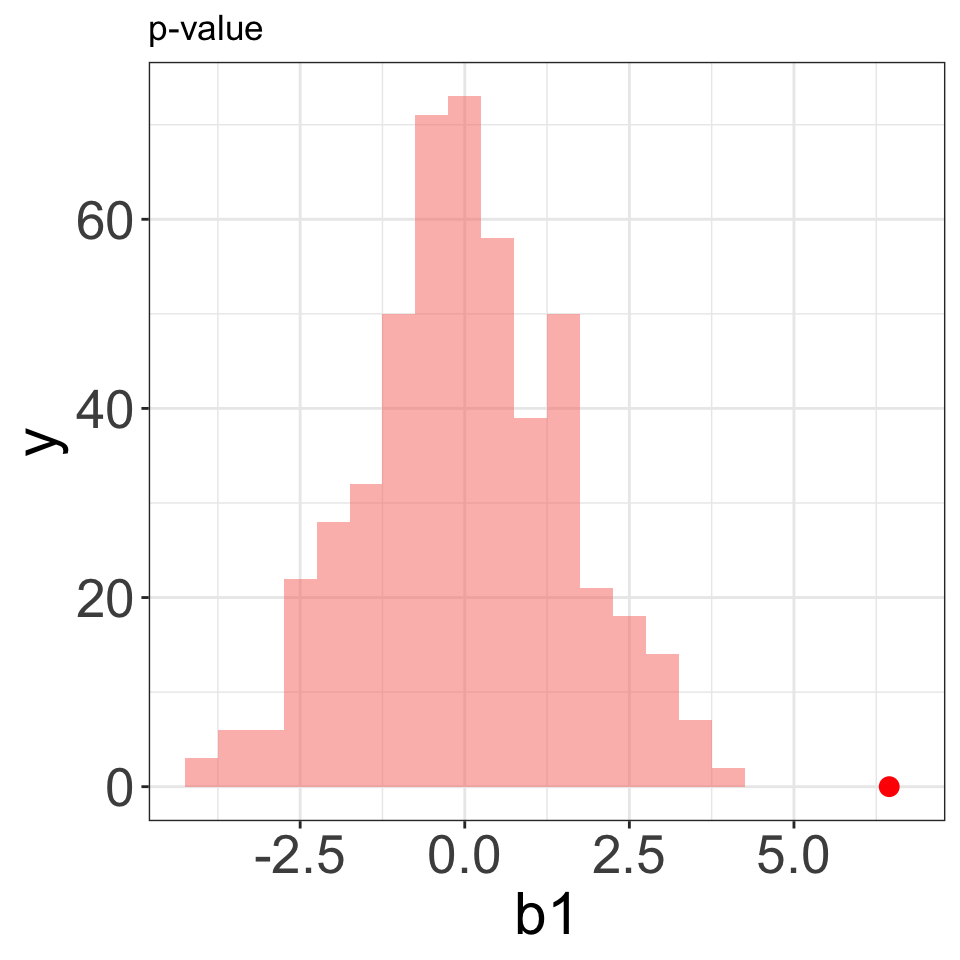
Null Distribution: Simulation

  • Simulate no Association:
    • Shuffle Outcome
  • Compute \(b_1\)
  • Repeat many times
  • Visualize (Histogram)
  • Add the observed value

Theotetical Null Distribution

Null Distribution: Mathematical Model

  • Assumption: Error Distribution \(\sim N(0, \sigma)\)

Categorical Explanatory

  • Normal
  • Mean of 0
  • Same group variances

Quantitative Explanatory

  • Normal
  • Mean of 0
  • Variance constant across \(X\)
  • Null Distribution: \(\frac{b_1}{s_{b1}}\sim t(df=n-2)\)

  • Sampling Distribution: \(\frac{b_1-\beta_1}{s_{b1}}\sim t(df=n-2)\)

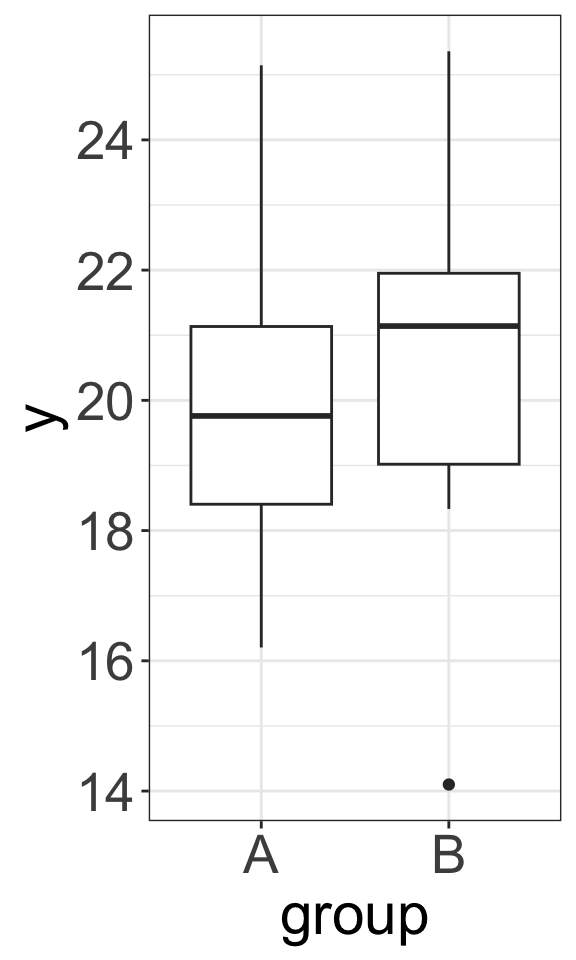
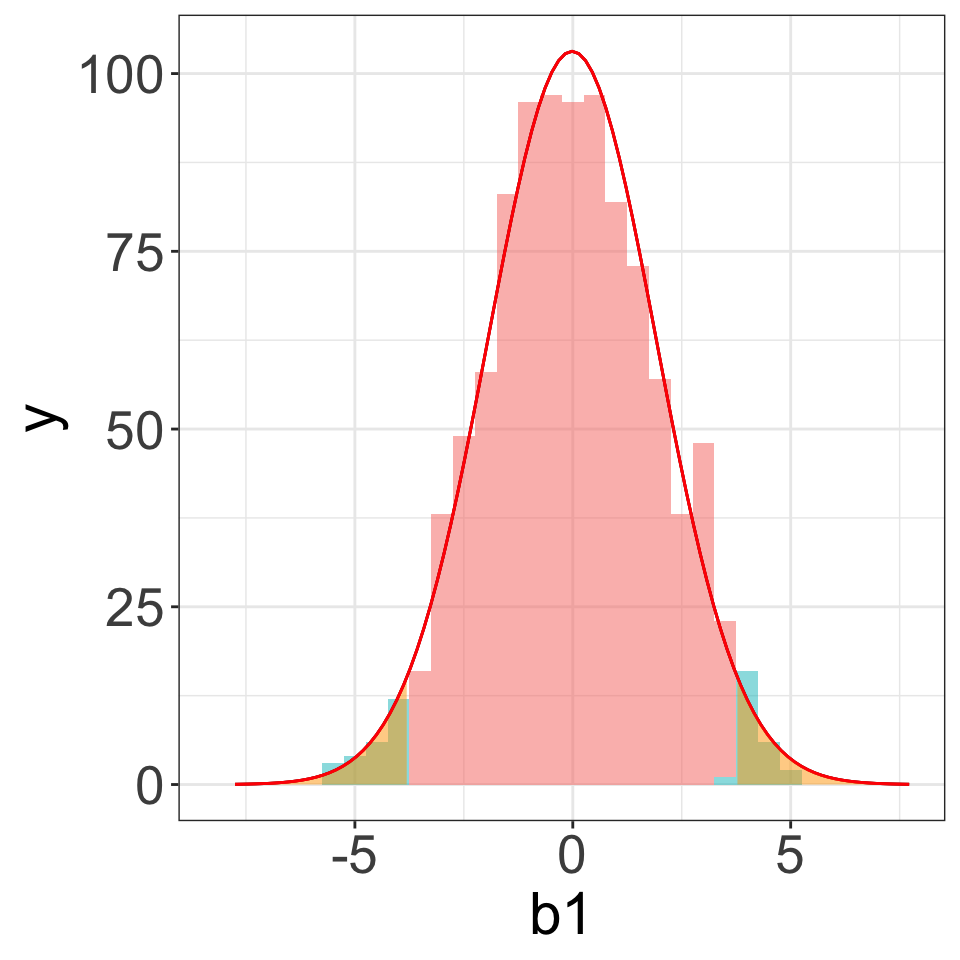
Example 1: Categorical Explanatory

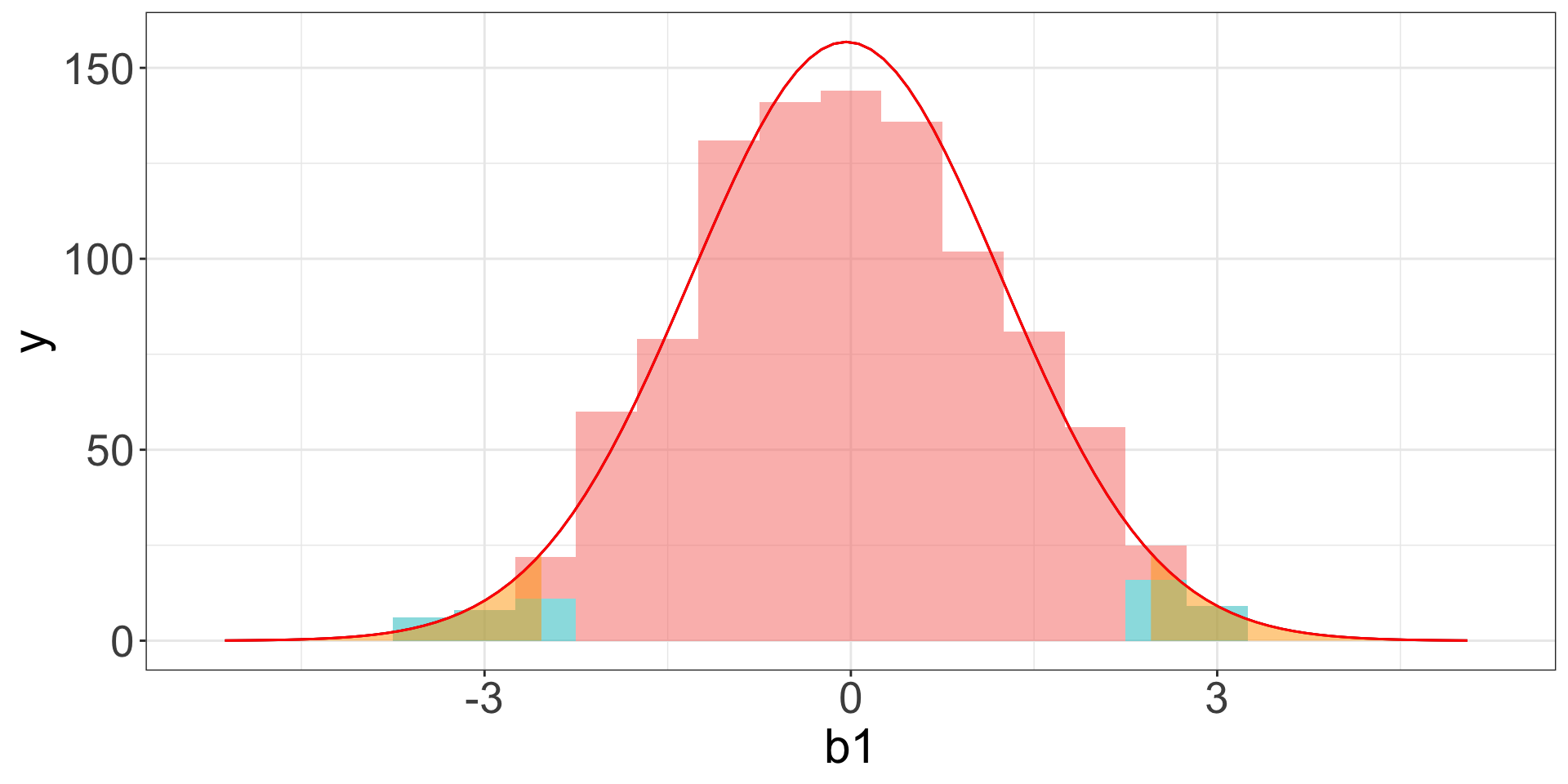
\[Y_A\sim N(20, 3), \quad Y_B\sim N(20, 3), \quad n_1=n_2=10\]
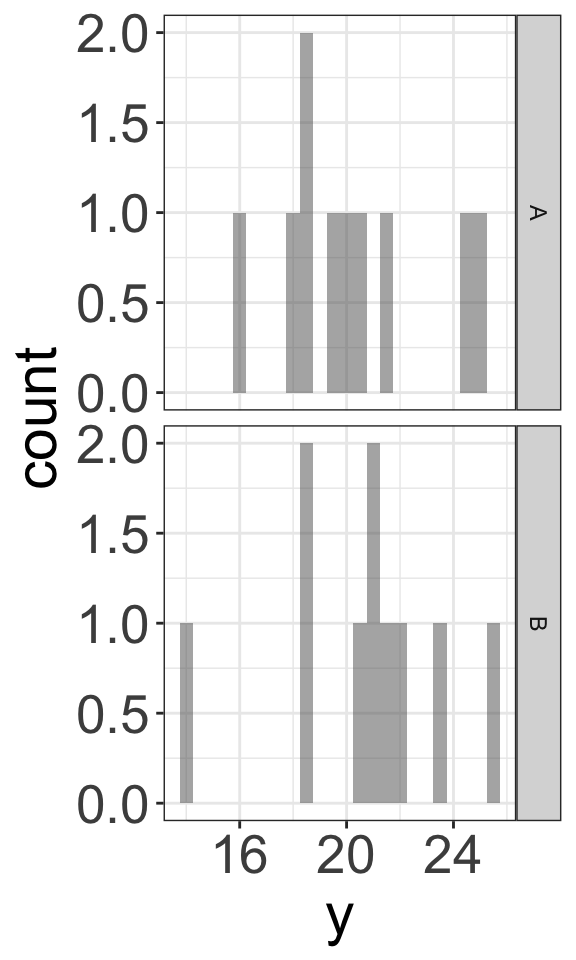
Example 1: Null Distributions

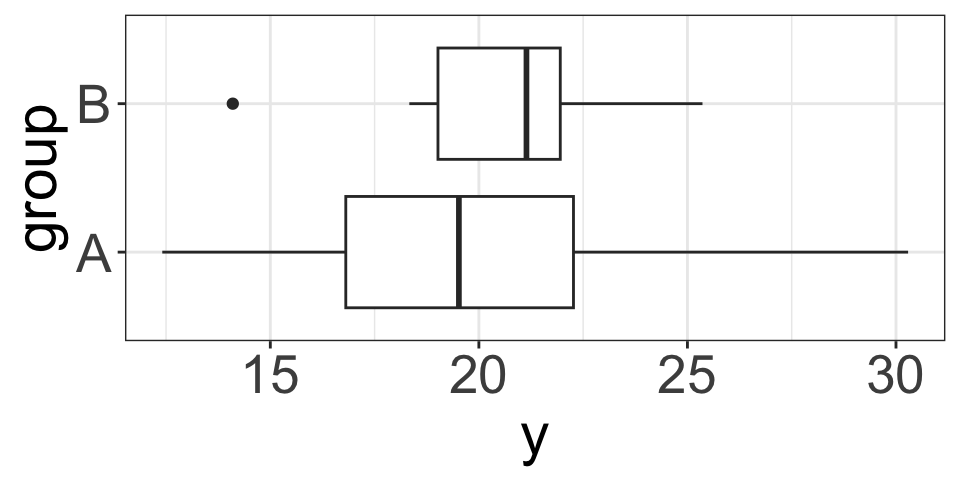
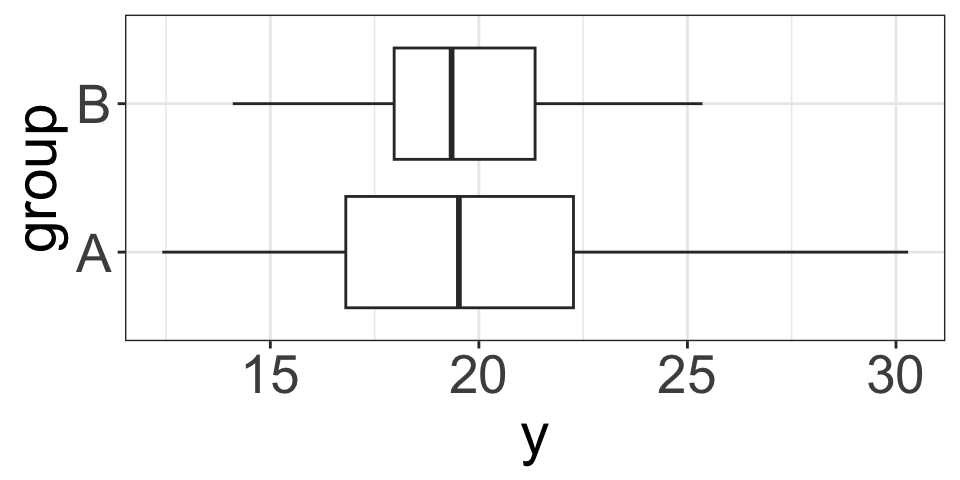
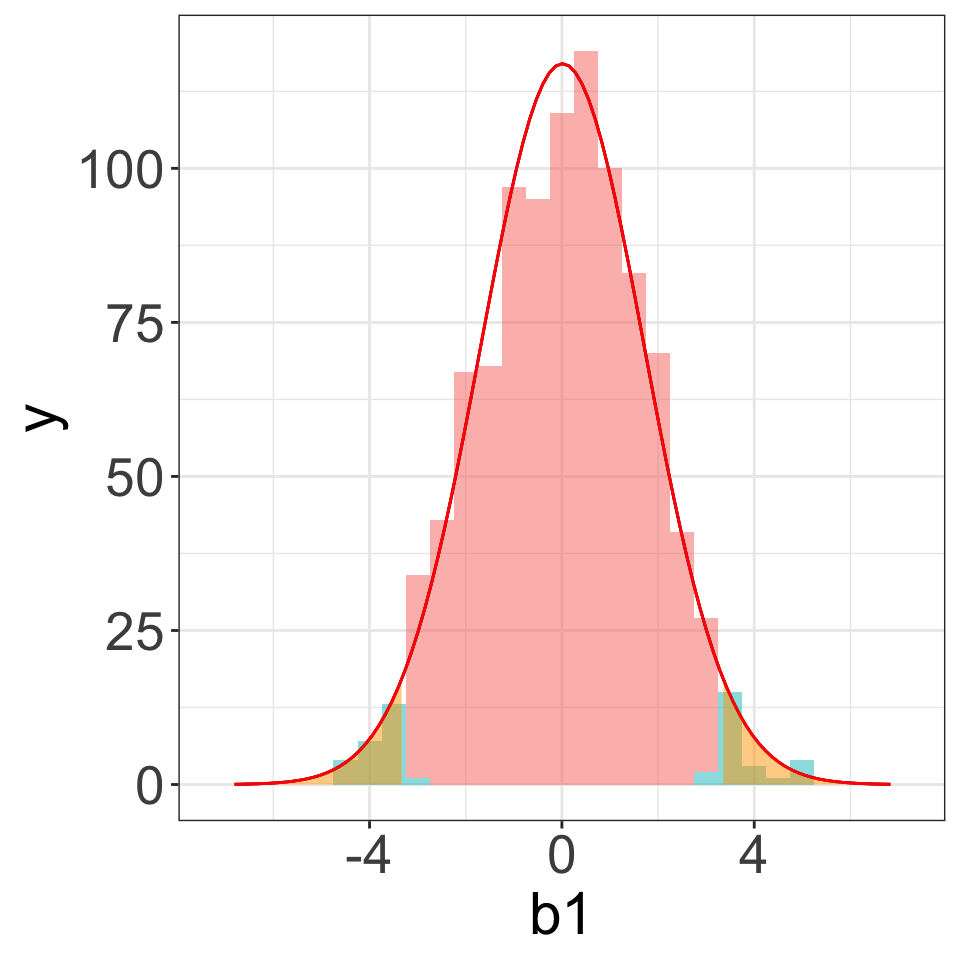
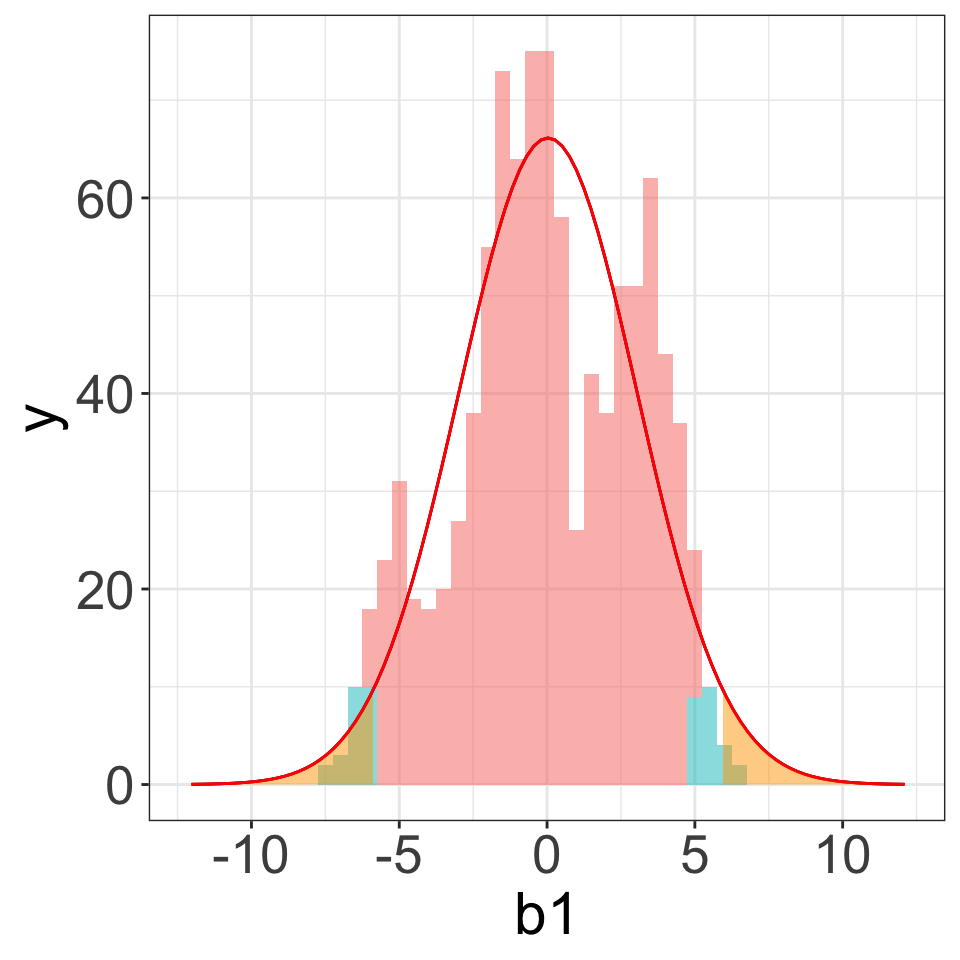
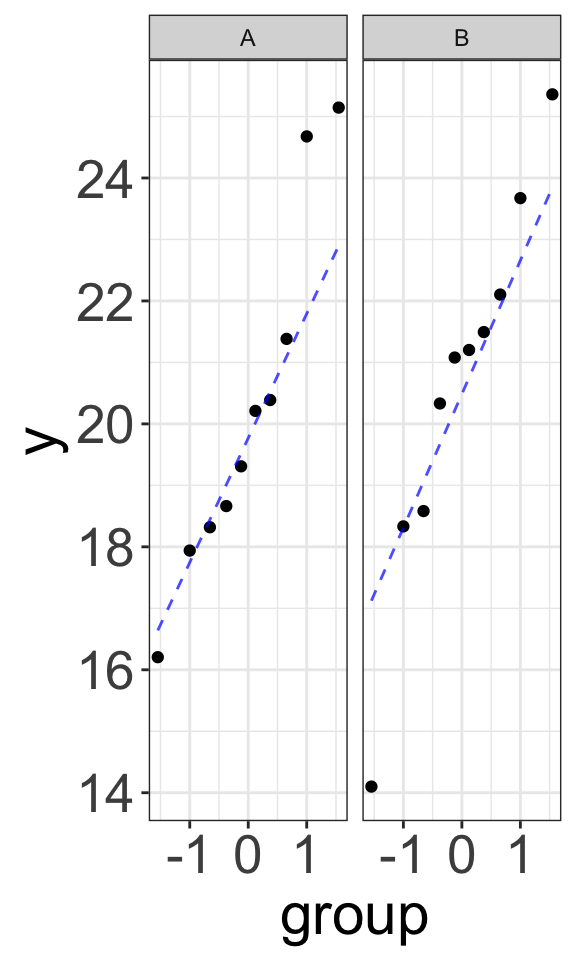
Example (2): Different Variance

\[Y_A\sim N(20, 6), \quad Y_B\sim N(20, 3), \quad n_1=n_2=10\]
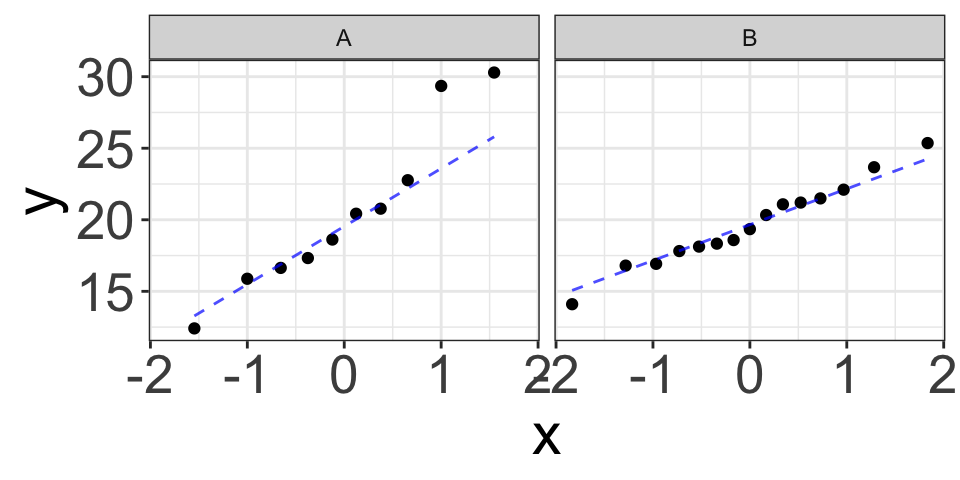
Example (3): Unbalanced Data

\[Y_A\sim N(20, 6), \quad Y_B\sim N(20, 3), \quad n_1=10, n_2=15\]
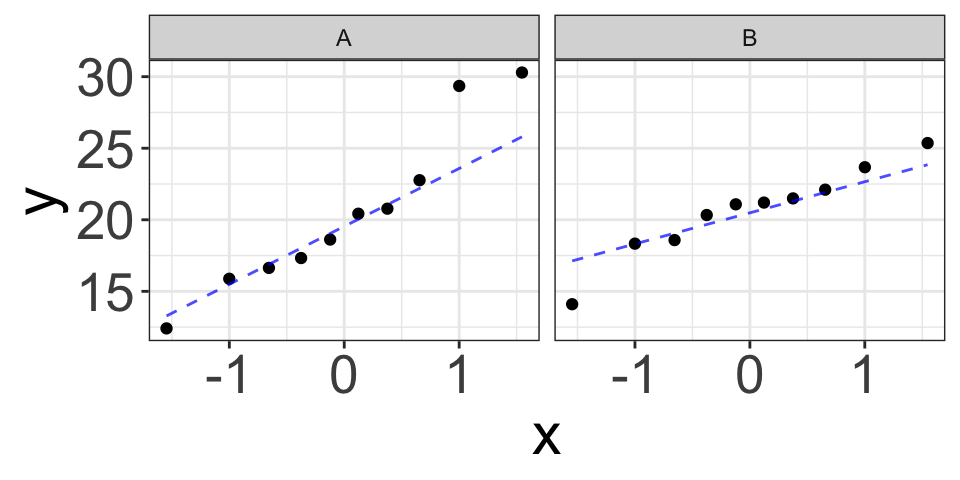
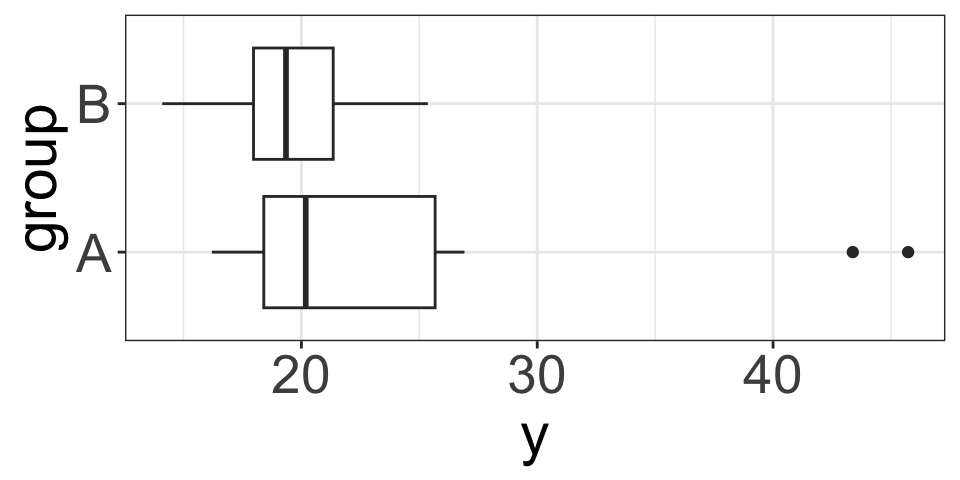
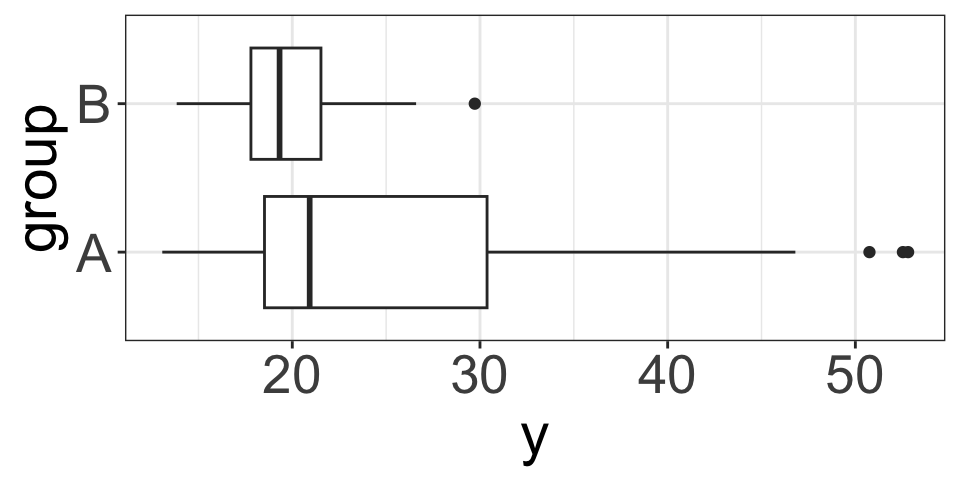
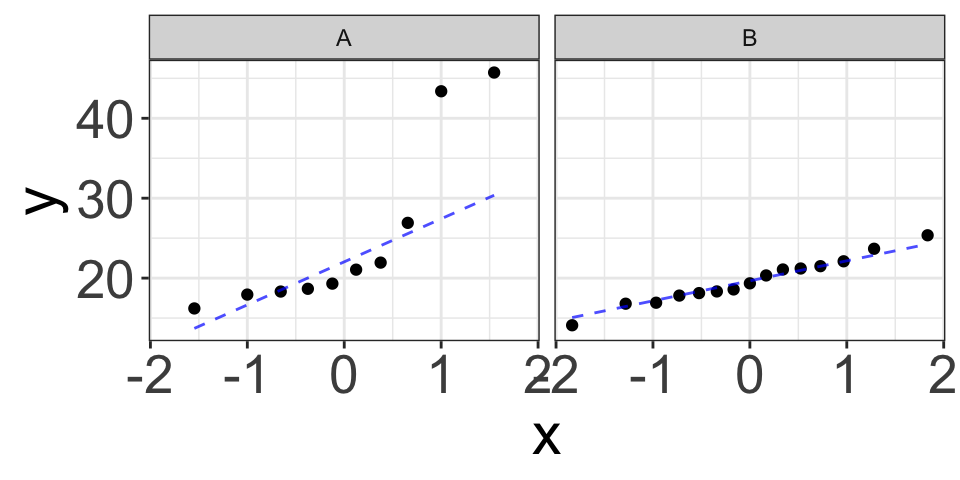
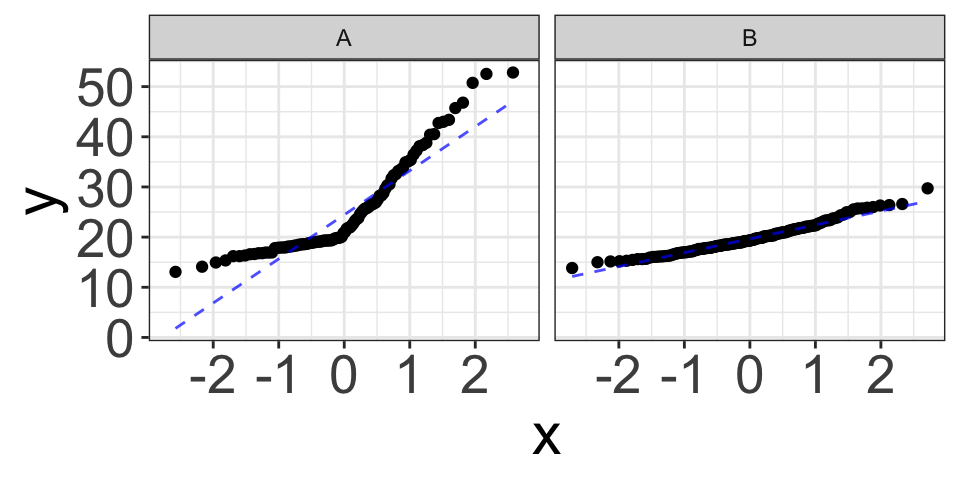
Example (4): Skewed Distribution

\[Y_A\sim N(20, 3), \quad Y_B\sim \text{skewed right}, \quad n_1=10, n_2=15\]
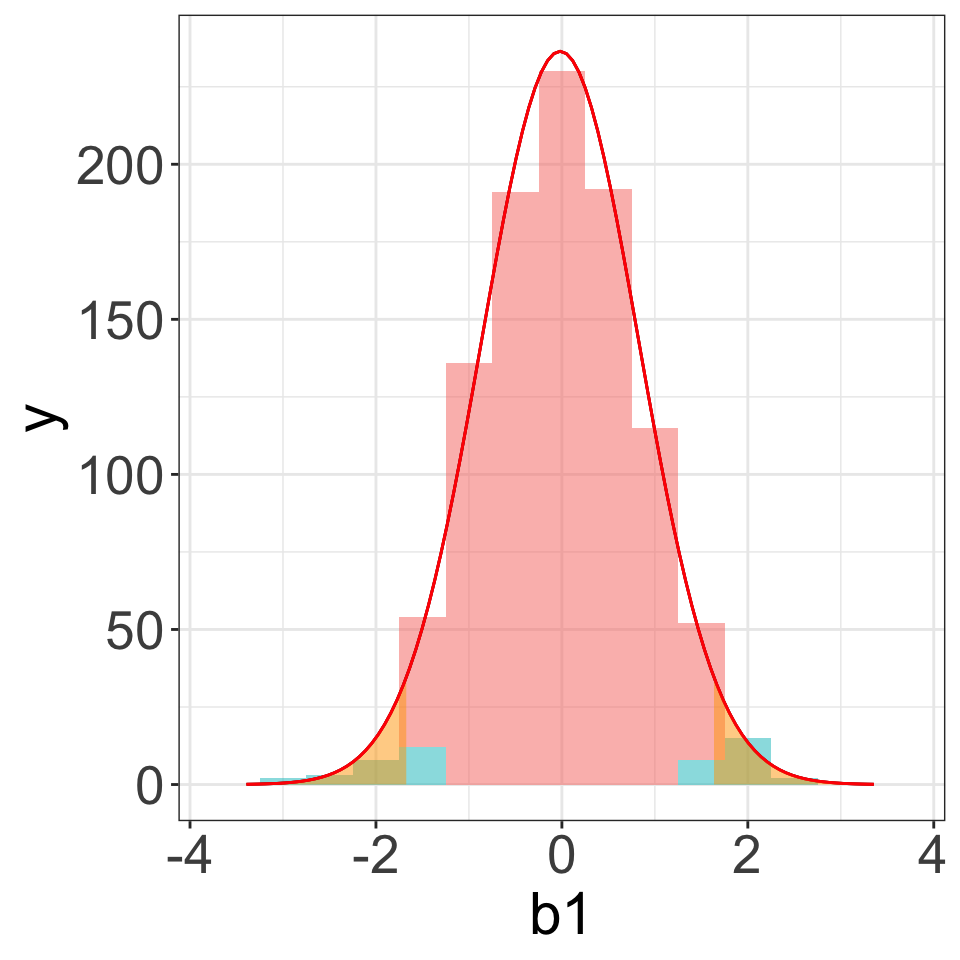
Example (5): Skewed & large \(n\)

\[Y_A\sim N(20, 3), \quad Y_B\sim \text{skewed right}, \quad n_1=100, n_2=150\]
Null Distribution Summary

For a binary numeriacl \(X\): \[Y=\beta_0+\beta_1 X + \varepsilon\] \[\frac{b_1-\beta_1}{s_{b_1}} \sim t(df=n-2)\]

  • If assumptions met:
    • Error Distribution \(\sim N(0, \sigma)\)
    • \(n\) is large
  • \(t(df)\):
    • a density centered at \(0\)
    • more spread than \(Z\)
    • as \(df (n)\to \infty, \quad t\xrightarrow{D} z\)

Test of Significance \(\beta_1\)

\(H_a\) & Unusual (Unexpected) Event

  • Assumption & \(H_0 \to\) Null Distribution
  • Alternative:
    • \(\beta_1>0\): Reject \(H_0\) if too far to the right.
    • \(\beta_1<0\): Reject \(H_0\) if too far to the left.
    • \(\beta_1\ne0\): Reject \(H_0\) if too far from the middle (expected).

Thumb~Gender Example

\[Thumb=\beta_0+\beta_1 Gender_{Male} + \varepsilon\] - \(H_0: \beta_1=0\) vs. \(H_a: \beta_1\ne 0\)
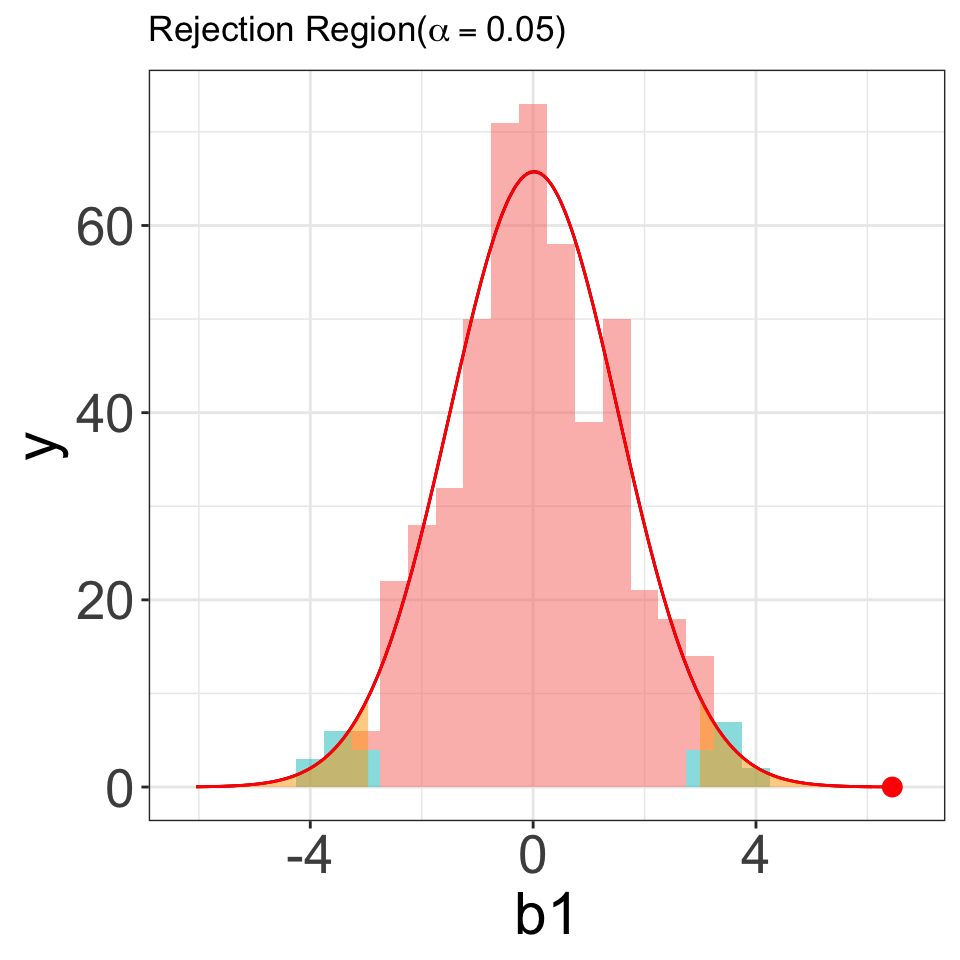
Probability of getting a result this extreme (or more) if the null is true

Decision

Reject \(H_0\), at \(\alpha\) significance level, if:

  • Observed \(b_1\) is in Rejection Region
  • \(p\)-value is less than \(\alpha\)

otherwise,

  • Fail to reject \(H_0\)
  • Both \(H_a\) and \(H_0\) are plausible.

Type I & II Errors

Type I Error

Rejecting a true null

  • False Positive
  • False Alarm

\[\begin{align*}\alpha &= P(\text{Rejecting } H_0|H_0) \\ \\ &=\frac{FP}{FP+TN}\end{align*}\]

Type II Error

Failing to reject a false null

  • False Negative
  • Missed Opportunity

\[\begin{align*}\beta &= P(\text{Not Rejecting } H_0|H_a) \\ \\ &=\frac{FN}{FN+TP}\end{align*}\]

Full Workflow

  1. State the null & Alt. hypothesis
  2. Find the null distribution of the test statistic
  3. Compute the observed (test) statistic
  4. Compute p-value or check against R.R.
  5. Make a decision & write a conclusion
  6. Check assumptions